
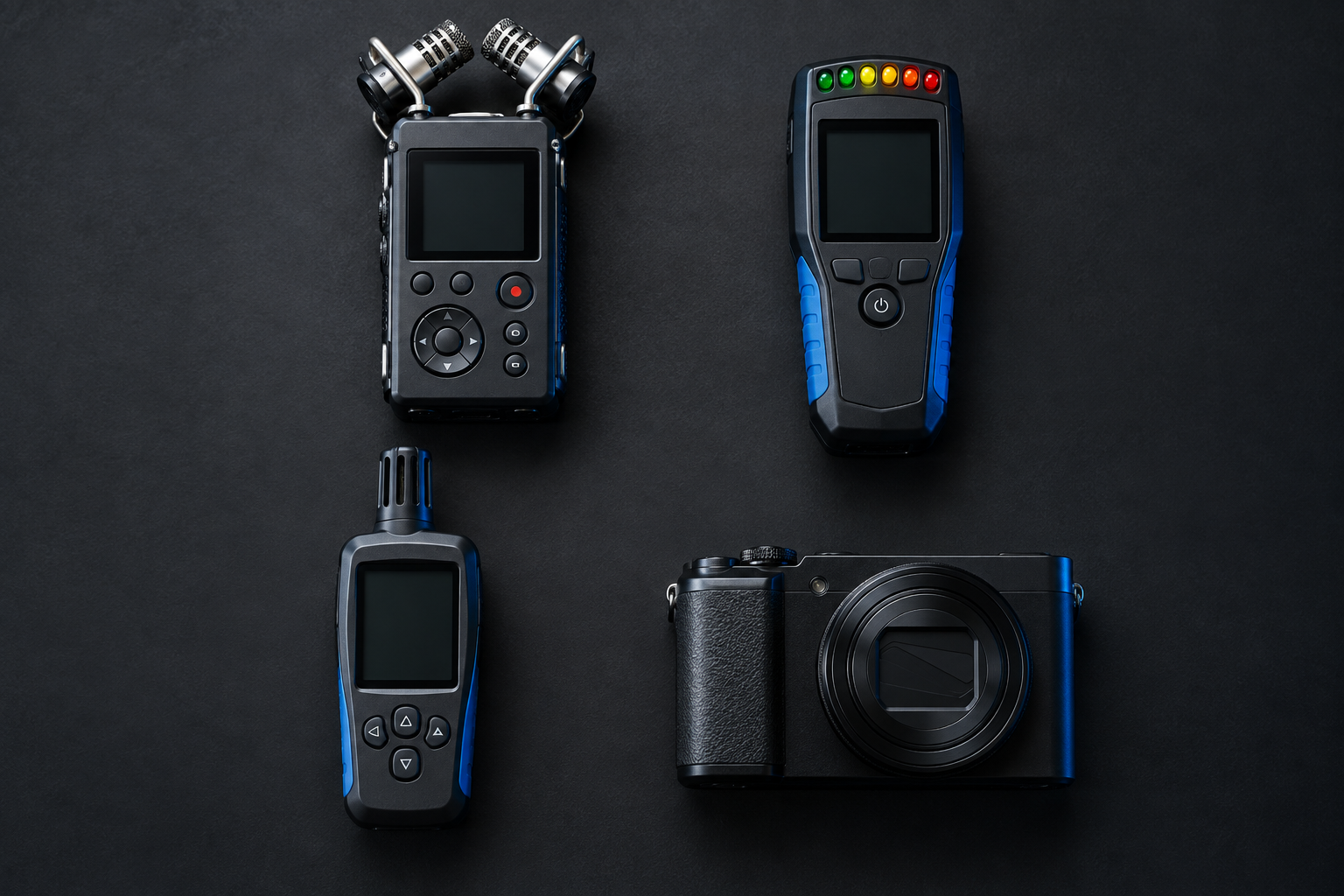
AI-generated illustrative equipment image.
Audio recorders
Log sample settings, microphone position, gain, clock offset, and nearby sound sources. Keep handling and movement away from the microphone when possible. Preserve the original recording before applying processing.
EMF meters
Record the model, sensor type, range, units, and orientation. Map ordinary electrical sources and compare at consistent positions. Different meters may measure different bands and are not automatically comparable.
Temperature sensors
Distinguish air temperature from surface temperature. Record units, position, response time, airflow, HVAC cycles, and repeated measurements. An infrared surface reading is not an air-temperature measurement.
Cameras and video
Keep original files and document exposure, focus, lighting, infrared illumination, and movement. Check dust, insects, reflections, motion blur, compression, and autofocus before interpreting a visual feature.
Radio sweep devices
Document band, sweep rate, direction, reception, and perceived phrase timestamps. Broadcast fragments are a conventional source that must be accounted for.
Device checks
- Check batteries, storage, clocks, and settings before the session.
- Use manufacturer operating guidance; record calibration or comparison checks.
- Keep instrument IDs consistent across maps, logs, and reports.
- Record failures, settings changes, interference, and uncertainty.
Worksheets for this topic
Equipment Deployment
Record device positions, settings, checks, and synchronized clocks.
DOWNLOAD FILLABLE PDFEMF Anomaly Log
Track an unusual reading alongside meter limits and electrical sources.
DOWNLOAD FILLABLE PDFTemperature Anomaly Log
Document a temperature change and test normal environmental causes.
DOWNLOAD FILLABLE PDF